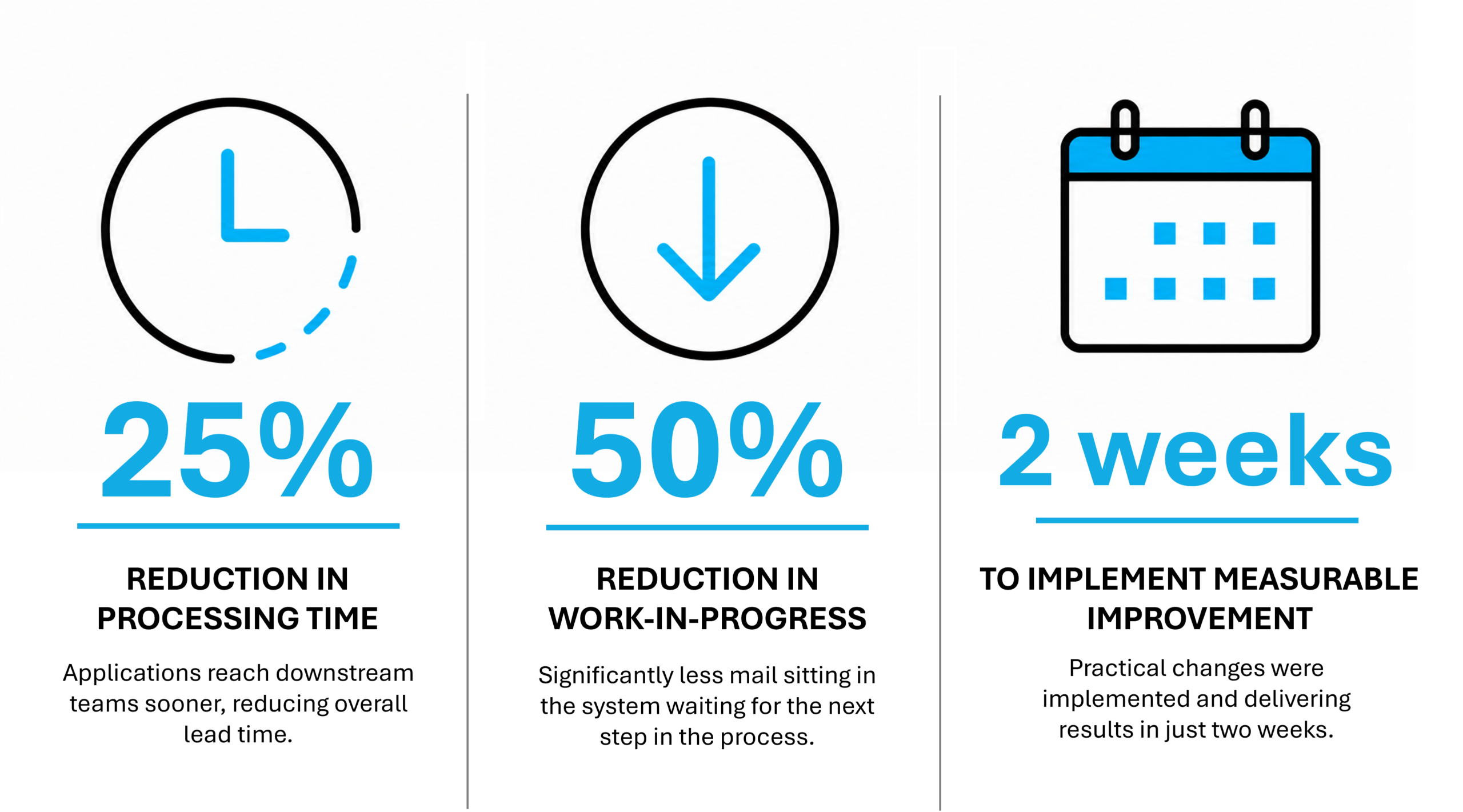
25% reduction in mail processing times with Rapid Improvement
To address processing delays and support service level commitments, Barrington worked with frontline employees to rapidly redesign mailroom workflows, achieving a 25% reduction in processing times and enabling licence applications to reach downstream teams more quickly.

Client
Federal Government Organization
Services
Operations and Lean Six Sigma
Industry
Government
The challenge
Backlogs were piling up in a large federal agency’s mailroom operations, creating delays in opening and processing incoming licence applications. With approximately 300,000 incoming pieces of mail handled annually, delays at the beginning of the process were having a downstream impact on licence application processing times and the agency’s ability to consistently meet established service level agreements (SLAs).
The challenge wasn’t simply to work faster. It was to rethink how work moved through the mailroom and identify practical changes that frontline employees could implement and sustain.
The solution
Barrington was engaged to lead a 2-week Rapid Improvement Workshop focused on improving the flow of work through the mailroom.
Using Lean Six Sigma principles, hands-on simulations, direct observation and collaborative problem-solving, Barrington worked alongside frontline employees to understand how work was currently performed, identify sources of waste and delay, and rapidly test and implement improvements.
Here’s what we did:
- Redesigned mail processing from batch to flow: Shifted from processing large daily batches to smaller, continuous flows, allowing applications to move to downstream teams sooner.
- Reduced bottlenecks and handoffs: Reviewed task sequencing and consolidated related activities to eliminate unnecessary waiting and movement between employees.
- Applied 5S workplace organization: Standardized shared workspaces, supplies and replenishment practices to reduce wasted time and create a more consistent working environment.
- Introduced visual management: Implemented a visual workboard to make work-in-progress visible, improve workload balancing and help the team identify emerging backlogs.
- Standardized documentation: Redesigned the process for documenting missing application information using defined categories and checkboxes, reducing administrative effort while improving consistency and reporting.
- Engaging frontline employees in solution design: Involved employees in identifying, testing and implementing improvements, helping build ownership of the new processes.
Rather than developing recommendations for future implementation, the Rapid Improvement Workshop focused on making practical changes during the engagement so the organization could begin realizing benefits immediately.
The results